
For decades, communities across Ohio, West Virginia, and Western Pennsylvania were viewed as some of the last truly affordable places to live in America.
That was part of the appeal of this region.
Families could still find quality housing without the crushing costs seen in larger metropolitan markets. Young professionals could start out on their own. Working families could rent responsibly while saving for homeownership. Employers could recruit talent because the cost of living remained manageable.
In many ways, affordability became part of the identity of the Ohio Valley.
But quietly, and almost without national attention, that reality has started to change.
And as someone whose family and company have spent nearly 70 years building, owning, and managing housing in this region, I can say firsthand:
creating quality affordable housing today is becoming extraordinarily difficult.
Not because owners or developers do not want to provide it.
Not because demand is not there.
And not because communities do not need it.
The problem is that the economics behind modern housing development have fundamentally changed.
This Is Personal For Us
Our company has been part of this region since 1957.
For generations, we have invested in communities throughout eastern Ohio and the Ohio Valley because we genuinely believe in them.
We are not an out-of-state institutional owner parachuting into a market looking for a quick return.
These are our communities. These are our residents. These are our local employers. These are the neighborhoods where our families live and work.
When we build housing, the goal is not simply to “maximize rent.”
The goal is to create:
safe housing
professionally managed housing
well-maintained housing
and long-term housing our communities can depend on
That mindset matters.
Because I think there is a growing misconception today that developers and landlords somehow benefit from rising housing costs.
In reality, many of us are deeply frustrated by what is happening.
We want to continue building quality housing. We want to continue investing locally. We want to continue serving workforce renters and middle-income households.
But the financial realities are becoming increasingly difficult to ignore.
A Real Project That Exposed the Problem
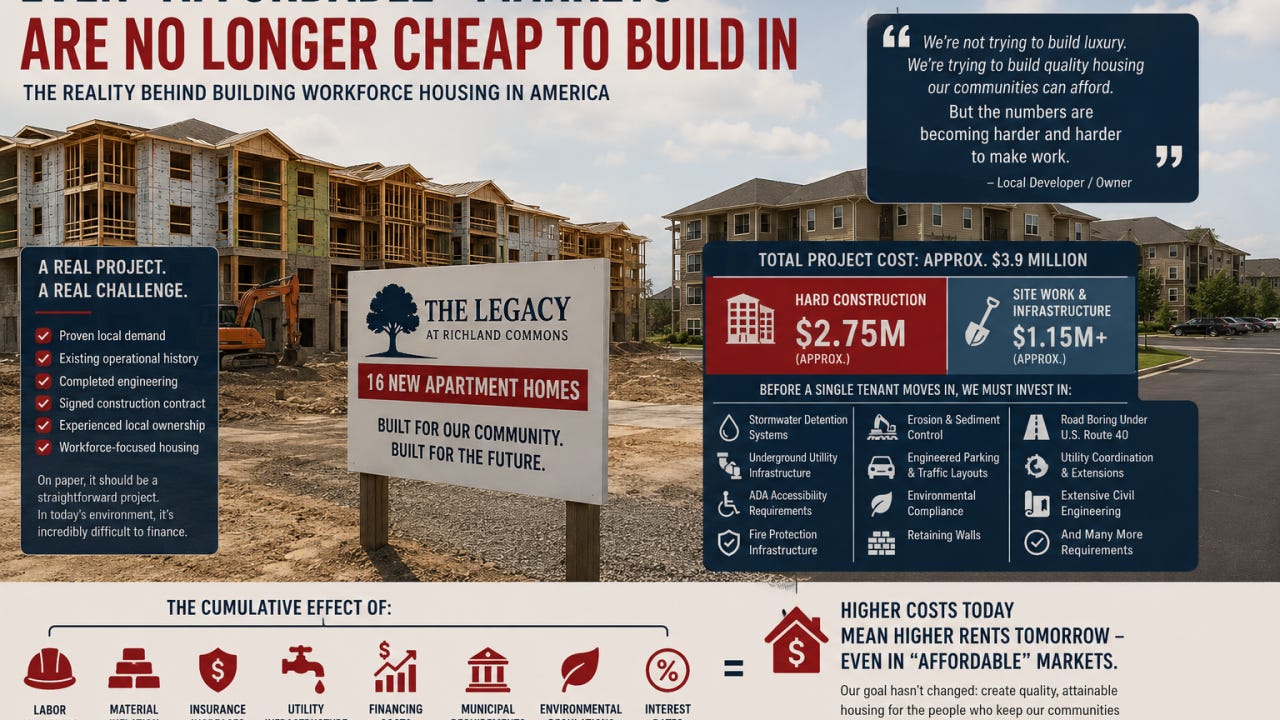
Recently, our team assembled a financing request for a new 16-unit apartment development in St. Clairsville, Ohio.
This was not a luxury development.
Not a high-rise. Not a speculative urban megaproject. Not a flashy mixed-use concept loaded with rooftop amenities.
It was a straightforward multifamily apartment building intended to expand an already successful apartment community that we currently own and operate.
Exactly the type of housing many communities say they desperately need more of.
The project was supported by:
proven occupancy history
existing rental demand
completed engineering
signed construction contracts
established management infrastructure
and comparable apartment buildings already operating successfully nearby
On paper, it should have been a relatively safe and straightforward project.
Instead, the financing conversations quickly became a lesson in what housing development now looks like in 2026.
The issue was not demand.
The issue was the cost of creating the housing in the first place.
The Public Sees Apartments. Developers See the Cost Stack.
Most people look at a new apartment building and see:
drywall
flooring
cabinets
parking lots
appliances
paint colors
But what they do not see is everything underneath the surface.
For this single 16-unit project, estimated total development costs approached nearly $3.9 million, including approximately $2.75 million in hard construction costs alone.
And the building itself was only part of the equation.
Before a single tenant could move in, the project also required:
stormwater detention systems
underground drainage infrastructure
utility extensions
ADA compliance
retaining walls
erosion and sediment control systems
fire suppression infrastructure
environmental controls
utility coordination
engineered parking layouts
road boring beneath U.S. Route 40
and extensive civil engineering
This is the part of development the public rarely sees.
And to be clear: many of these requirements exist for good reasons.
Safety matters. Environmental protection matters. Accessibility matters. Infrastructure matters.
But collectively, these requirements dramatically increase the baseline cost of building housing.
And those costs continue climbing.
The Math No Longer Works Like It Used To
Historically, Midwest markets benefited from a simple advantage: construction costs and achievable rents were relatively balanced.
That balance is disappearing.
Today, developers are being squeezed from every direction:
labor shortages
material inflation
rising insurance costs
interest rate increases
utility infrastructure expenses
financing constraints
environmental compliance
and municipal requirements
At the same time, many communities still expect rents to remain at levels that reflect older development economics.
But modern projects are no longer being built under yesterday’s costs.
That creates an increasingly dangerous disconnect between:
what housing costs to build
what lenders are willing to finance
and what working households can realistically afford to pay
And that disconnect is becoming one of the defining economic problems facing housing today.
The ROI Reality Nobody Wants to Talk About
One of the biggest misconceptions about apartment development is that every project produces massive profits.
The truth is that many workforce housing developments today produce surprisingly modest returns relative to the amount of capital and risk involved.
When lenders review projects now, they are evaluating:
debt coverage ratios
construction risk
stabilization timelines
reserve requirements
interest rate exposure
operating costs
and long-term cash flow sustainability
And frankly, many projects that would have worked financially several years ago simply do not work under today’s lending environment.
That is one of the reasons housing production has slowed in many markets despite obvious demand.
Developers are not walking away because communities do not need housing.
They are walking away because the financial risk increasingly outweighs the potential return.
That should concern everyone.
Because if financially disciplined, experienced local operators cannot make workforce housing projects work consistently, fewer projects will get built.
And when supply slows while demand continues growing, affordability deteriorates even further.
This Is About More Than Real Estate
Housing is not just a real estate issue.
It affects:
workforce retention
economic development
healthcare staffing
school systems
young families
and long-term community stability
If teachers, nurses, tradespeople, young professionals, and middle-income families cannot find quality attainable housing, communities eventually feel the consequences everywhere.
And that is why this conversation matters so much.
Because despite the headlines, most local developers and landlords I know are not trying to create a housing crisis.
We are trying to solve one.
We want to build. We want to improve communities. We want to provide quality housing people can afford. We want long-term residents and stable neighborhoods.
But the economics of modern development are making that mission harder every year.
The Industry Needs a Smarter Conversation
America absolutely needs more housing.
But the conversation can no longer stop at:
“Just build more.”
Because the reality on the ground is far more complicated.
The future of housing affordability will require:
smarter development policies
operational efficiency
public-private cooperation
infrastructure planning
financing innovation
and a serious discussion about how housing can remain financially attainable to both residents and the people building it
Because right now, even in historically affordable Midwest markets, the numbers are becoming harder and harder to make work.
And if we truly care about affordable housing, we have to start acknowledging the reality behind what it now costs to create it.
Originally published on LinkedIn on May 18, 2026. Republished here from the original article.
Emily C. Shortall, CPM®, ARM®, also known professionally as Emily Goodman Shortall and Emily Shortall, works in commercial and multifamily property management and provides operational advisory and separately engaged expert-witness services. Historical bylines are retained for attribution; they are not a statement of current credential status.