
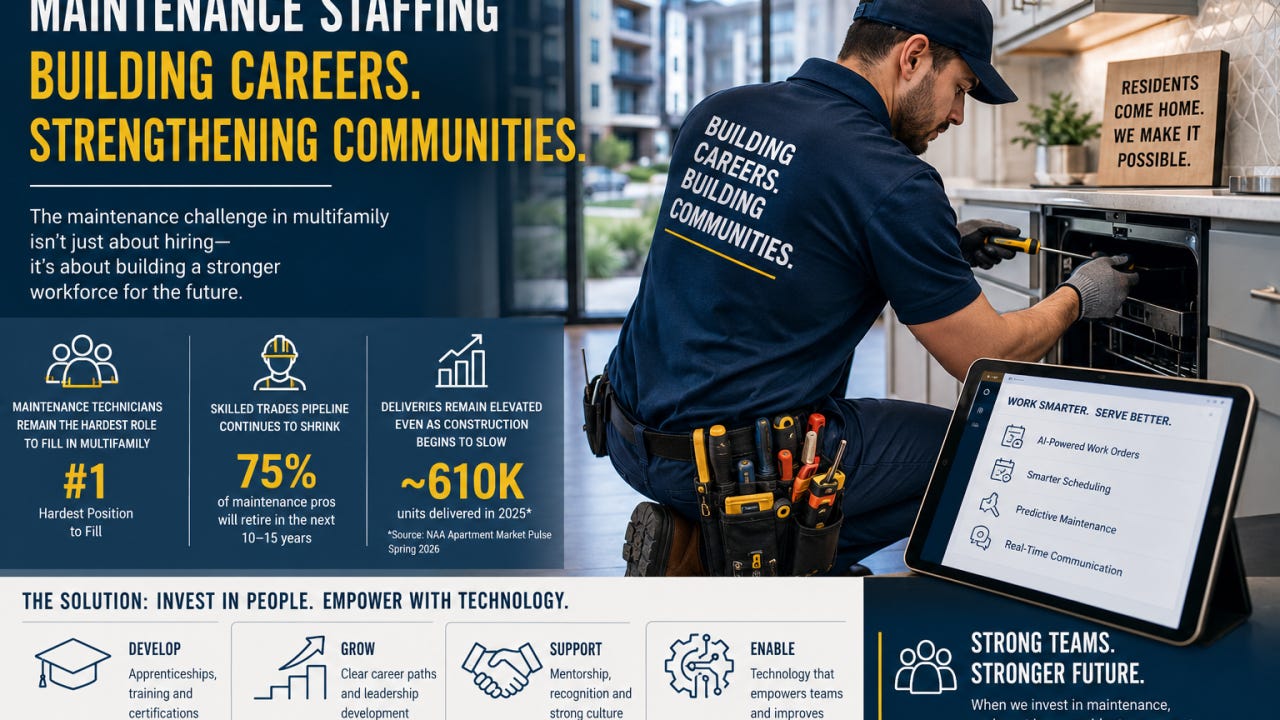
Every few months, another article highlights the same concern: multifamily operators are struggling to hire maintenance technicians.
The statistics haven’t changed much. Service technicians remain the hardest position to fill, experienced employees are retiring, and recruiting has become increasingly competitive. Companies are responding with higher wages, signing bonuses, mentorship programs, apprenticeship initiatives and expanded training.
Those are all positive steps.
But after more than two decades in property management, I believe we’re asking the wrong question.
The question isn’t, “Why can’t we hire maintenance technicians?”
The better question is, “Why aren’t enough people entering the skilled trades in the first place?”
This Isn’t Just a Multifamily Issue
Property management is competing for the same workforce as hospitals, manufacturers, data centers, municipalities, utilities, logistics companies and commercial real estate.
An experienced maintenance technician today can choose from dozens of industries.
Many of those jobs offer predictable schedules, fewer emergencies, limited weekend work and less customer-facing responsibility. Multifamily simply isn’t competing against the apartment community across town—it’s competing against nearly every industry that relies on skilled trades.
That’s why increasing wages alone won’t solve the problem.
The Maintenance Technician of 2026 Is a Different Professional
The role has changed dramatically over the past decade.
Today’s technician is expected to understand HVAC systems, plumbing, electrical troubleshooting, appliances, carpentry and drywall repair. Increasingly, they’re also expected to work with smart locks, connected thermostats, access control systems, security cameras, leak detection devices, Wi-Fi-enabled equipment and other connected building technologies.
At the same time, they remain the face of the property whenever something goes wrong.
They’re not just fixing equipment—they’re protecting resident satisfaction, preserving asset value and representing the property’s brand.
We Need to Stop Recruiting for Jobs and Start Building Careers
One of the biggest mistakes our industry makes is marketing maintenance as a position instead of a profession.
The best technicians aren’t looking for another hourly job.
They’re looking for a future.
Imagine if every management company could clearly demonstrate a career path like this:
Maintenance Apprentice
Maintenance Technician I
Maintenance Technician II
Lead Technician
Service Manager
Regional Maintenance Manager
Facilities Director
Pair that progression with paid certifications, mentorship, leadership development and exposure to capital projects, and the conversation changes.
People don’t just stay for pay.
They stay because they can see what’s next.
Technology Won’t Replace Maintenance Teams—It Will Empower Them
Artificial intelligence has become part of nearly every conversation in property management.
Some worry AI will replace on-site teams.
I believe the opposite.
No software is going to replace someone rebuilding a pump, diagnosing an electrical fault or repairing a water line.
Where AI can make an immediate difference is eliminating administrative work.
Imagine technicians who spend less time writing work-order notes, searching equipment manuals, updating residents or documenting repairs—and more time actually solving problems.
That’s where technology creates value.
The goal shouldn’t be fewer technicians.
The goal should be better-supported technicians.
The Real Competitive Advantage
For years, multifamily has competed on compensation.
Going forward, I believe the companies that win the talent battle will compete on something much more valuable:
Opportunity.
The organizations that invest in apprenticeship programs, technical education, certification reimbursement, mentorship, leadership development and modern technology won’t simply fill open positions.
They’ll build a workforce.
And that’s an investment that improves resident satisfaction, protects property value, strengthens company culture and ultimately drives better financial performance.
Looking Ahead
The maintenance staffing challenge isn’t going away next year.
In many ways, we’re only beginning to feel the effects of an aging workforce and decades of declining participation in the skilled trades.
That means the future belongs to organizations willing to think differently.
Not just about recruiting.
But about developing people, embracing technology and elevating maintenance from a support function to a strategic asset.
Because at the end of the day, our buildings are only as strong as the people who keep them running.
What are you seeing in your markets? Are maintenance staffing challenges improving, or are they becoming even more difficult? I’d love to hear how your organization is approaching recruitment, training and retention.
Originally published on LinkedIn on July 2, 2026. Republished here from the original article.
Emily C. Shortall, CPM®, ARM®, also known professionally as Emily Goodman Shortall and Emily Shortall, works in commercial and multifamily property management and provides operational advisory and separately engaged expert-witness services. Historical bylines are retained for attribution; they are not a statement of current credential status.