
There is a particular kind of compliment in property management that makes me pause: “Nothing happens here without her.”
It may describe someone who is knowledgeable, committed, and exceptionally good at the job. But it also raises a question: What happens when she is not there?
If the answer is that approvals stall, vendor instructions disappear, and nobody knows what was promised to a resident or commercial tenant, I would look beyond that individual’s performance. I would look at how the operation has been built around her.
A capable property manager is essential. That person should not have to be the organization’s memory, approval process, escalation path, and backup plan.
When being indispensable becomes a burden
I value people who take ownership. Property management requires judgment, initiative, and a willingness to stay with a problem when the first answer does not resolve it.
But I draw a distinction between taking responsibility and personally holding together every connection in an operation.
Consider a hypothetical manager who knows which vendor needs a second call, which repair is waiting on owner approval, what a tenant was told last Thursday, and why an invoice does not match the original scope. She also knows that an apparently routine maintenance request is the third report of the same condition.
That knowledge is valuable. If it exists only in her memory, private messages, and inbox, however, the organization has made continuity dependent on her availability.
The question is not whether she can handle a busy day. The question is whether someone else can understand the work well enough to carry it forward.
The time pressure behind the problem
In NAA’s 2025 Performance Ecosystem research, respondents reported spending 42% of their workweek on routine operational work and 24% on reactive tasks: 66% combined. (AppFolio’s survey summary)
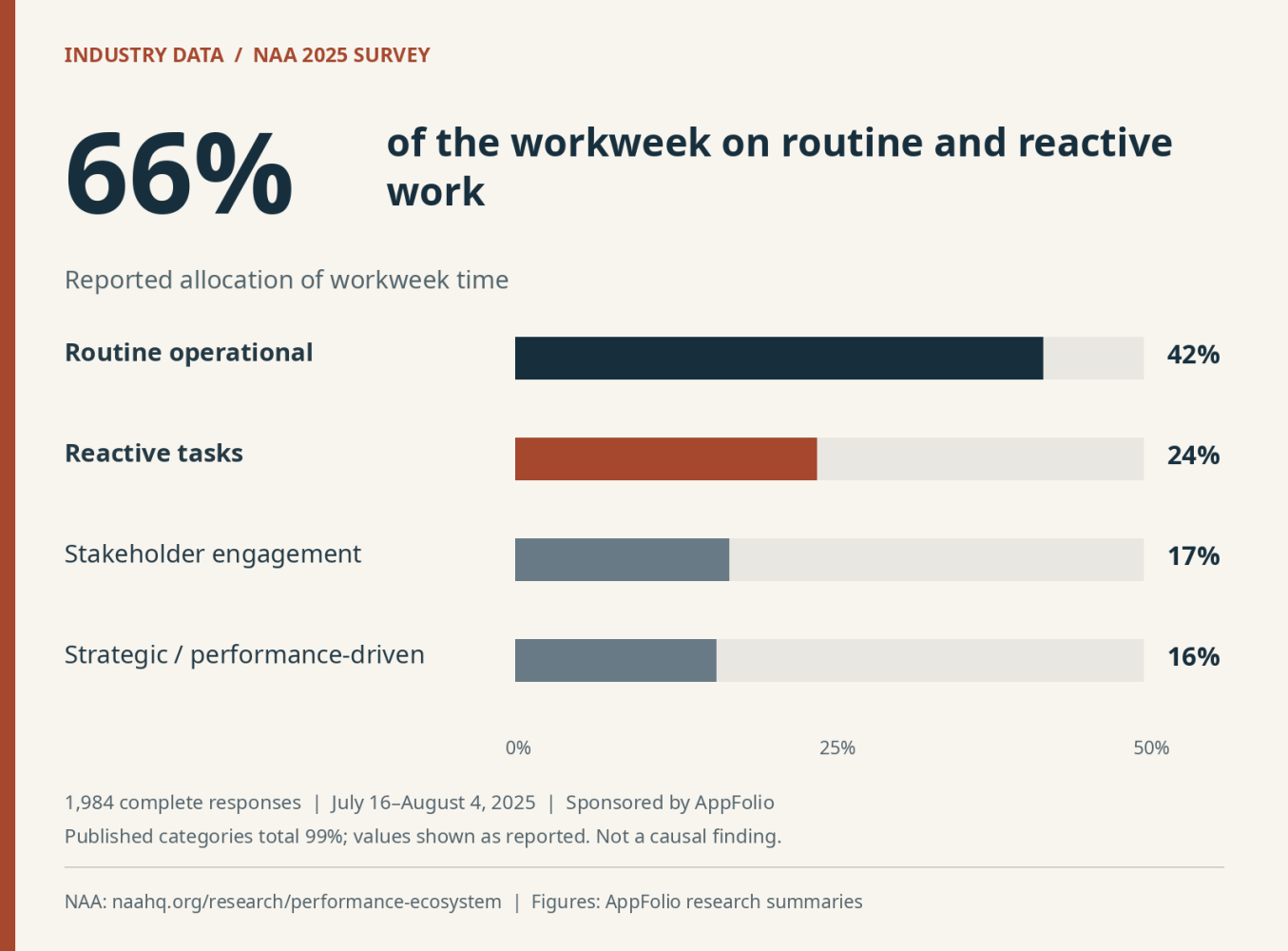
The NAA survey, sponsored by AppFolio, received 1,984 complete responses from U.S. industry professionals between July 16 and August 4, 2025. (NAA survey methodology) The reported allocations for stakeholder engagement and strategic work were 17% and 16%, respectively. (AppFolio’s research announcement)
I would not call routine work wasted time. Inspections, maintenance coordination, and tenant communication are part of operating a property. Nor do these survey results establish that dependence on one person caused the reported allocation of time.
For me, the figures sharpen a leadership question: What capacity are we leaving for supervision, planning, and building a process that works when a key person is unavailable? I am using rental-housing industry research as context, not as a benchmark for every commercial or multifamily team.
Follow one unresolved problem
When I think about whether a management process works, I find it more useful to follow one unresolved issue than to start with an organizational chart.
Take a recurring leak. A tenant reports it. Maintenance investigates. A vendor recommends additional work. The proposed cost exceeds the manager’s approval authority.
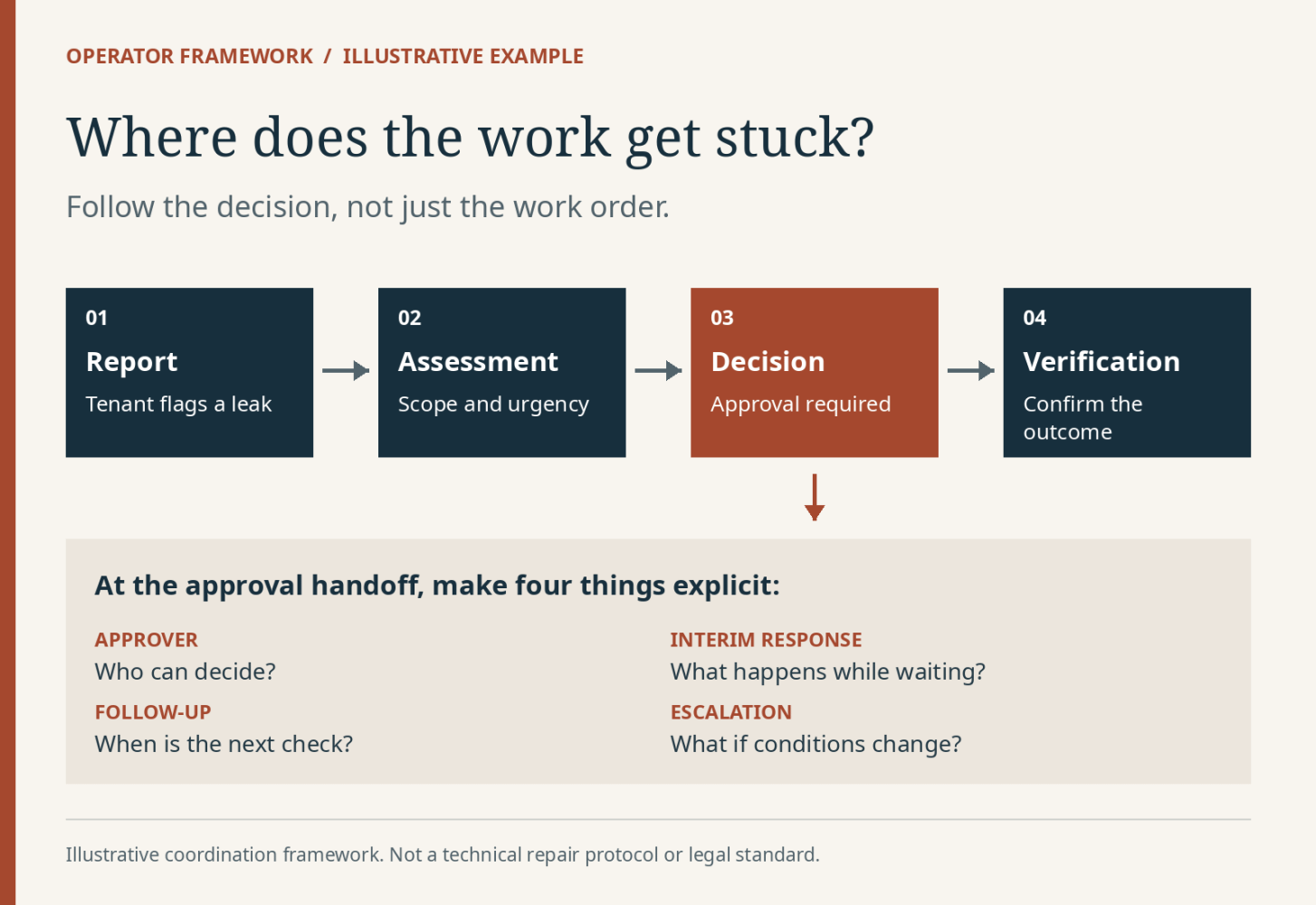
This is an illustrative coordination framework, not a technical repair protocol. The actual response depends on the condition, urgency, management authority, and appropriate specialist input.
Now ask:
Responsibility: Who owns the issue while the repair is pending?
Authority: Who can authorize the next step, and what information do they need?
Interim response: What appropriate measures can be taken within the team’s authority while a decision is outstanding?
Communication: Who updates the tenant, and when?
Escalation: What happens if approval does not arrive or the condition changes?
Verification: Who confirms what was completed and whether further follow-up is needed?
“The manager is handling it” does not answer all of those questions.
The manager may be coordinating the response, but coordination does not give that person unlimited spending authority, technical expertise, or control over someone else’s decision. Leadership has to make those boundaries workable.
Responsibility needs authority and support
I would not evaluate a manager’s follow-through without also asking what the organization made possible.
Was the approval limit clear? Was there a designated decision-maker? Did the manager know where to escalate an unanswered request? Was there sufficient coverage to inspect the work, communicate with the tenant, and address the rest of the property’s demands?
Accountability should not stop at the property manager’s desk. It should extend to the people responsible for resources, approvals, priorities, and supervision.
That does not remove the manager’s responsibility to act within the role. It makes the role more clearly defined and more realistically supported.
There is a meaningful difference between a manager who does not follow an established process and a manager who has been left to invent the process while responding to the problem.
Build a record someone else can use
My goal would not be to document every conversation twice or add another report nobody reads. It would be to leave a usable record of the work.
For an unresolved item, another person should be able to identify:
Current condition: What is known, and what remains uncertain?
Action taken: What has already been done?
Next step: What needs to happen now?
Assigned owner: Who is responsible for moving it forward?
Pending decision: What approval or outside input is needed?
Follow-up point: When should the item be checked again, or what change should trigger escalation?
That record might live in a work-order platform, an appropriate shared tracker, or another established system. I would focus less on the sophistication of the tool than on whether the information is current, accessible to the right people, and actually used.
A software subscription is not a substitute for deciding who does what.
A usable record should let the next authorized person act without reconstructing the entire history.
Use the absence test
Here is a practical leadership question: If the manager were unexpectedly unavailable tomorrow, could another authorized team member identify the most important unresolved issues and take the next appropriate steps?
Not perform every part of the manager’s job. Not replace years of experience. Simply keep essential work moving without guessing.
Could that person locate pending approvals, understand commitments made to tenants, reach the appropriate vendors, and distinguish a routine open item from one requiring prompt attention?
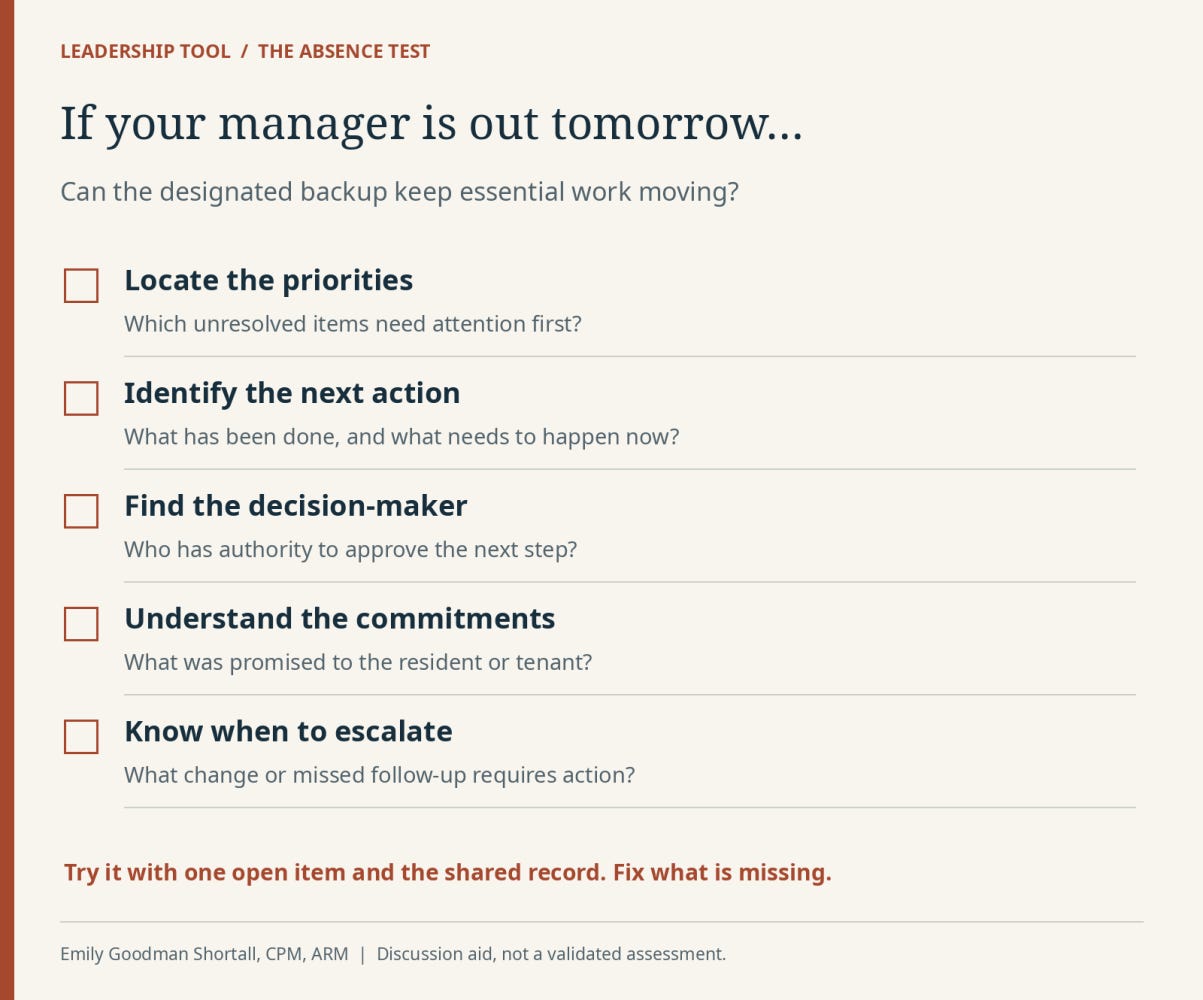
Try this in the next operating meeting: choose one unresolved item and ask the designated backup to walk through it using the shared record. Wherever the explanation depends on “you would have to ask the manager,” identify what information or authority is missing.
If not, I would treat that as a continuity problem to address, not evidence that the manager needs to be more available.
A person should be able to take time away without remaining the invisible coordinator of the property.
Keep judgment at the center
None of this is an argument for managing properties by checklist alone. A written process cannot anticipate every condition, and a dashboard cannot make every judgment.
The purpose of structure is to give experienced people the information, authority, and support to exercise judgment well. It should reduce avoidable reconstruction and uncertainty, not create administrative work for its own sake.
For me, the leadership goal is not to make a strong property manager less important. It is to make that person’s contribution sustainable.
I would rather hear, “She built a team and a process that keep the property moving,” than, “Nothing happens unless she is here.”
Where does your operation still depend on one person remembering the next step, and what would make that work transferable?
Emily Goodman Shortall, CPM, ARM, is a commercial and multifamily property operator whose work includes operational consulting and property-management expert-witness services.
Originally published on LinkedIn on September 18, 2026. Republished here from the original article.
Emily C. Shortall, CPM®, ARM®, also known professionally as Emily Goodman Shortall and Emily Shortall, works in commercial and multifamily property management and provides operational advisory and separately engaged expert-witness services. Historical bylines are retained for attribution; they are not a statement of current credential status.