
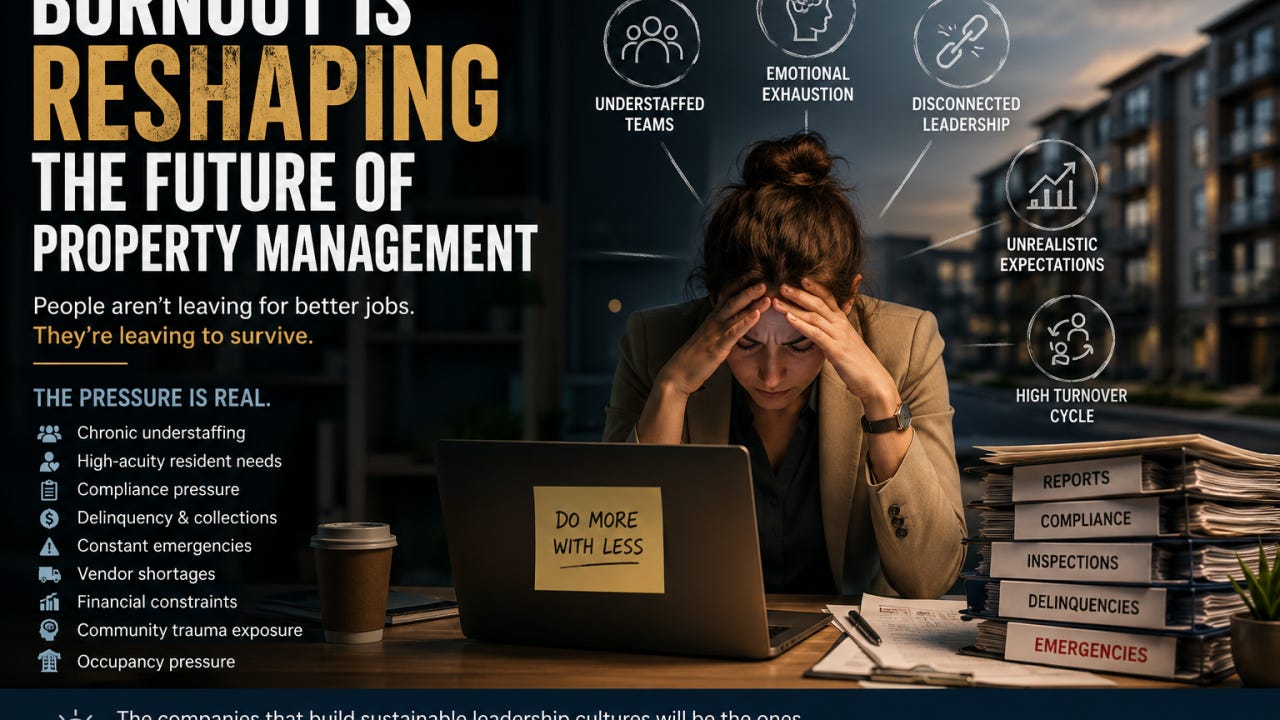
For years, the property management industry has struggled with turnover.
But what we are seeing today is different.
Over the last several years, one trend has become impossible to ignore in property management:
Experienced people are leaving the industry faster than many organizations can replace them.
And it is not just entry-level turnover anymore.
Some of the industry’s strongest operators — people who genuinely care about residents, communities, asset performance, and operational excellence — are burning out.
Calling it a staffing crisis almost does not go far enough.
This is a structural shift.
And the data is finally starting to catch up with what operators on the ground have been feeling for years.
In multifamily housing alone, annual employee turnover rates are now hovering around 33%–36%, significantly higher than the national average of roughly 22%.
Think about that for a moment:
One out of every three employees is leaving every year.
And in many cases, it is not the weakest employees walking out the door.
It is the strongest ones.
So What Is Actually Driving This?
The easy answer is compensation.
And yes — in a competitive labor market where most companies report difficulty finding skilled talent, pay absolutely matters.
But research and real-world operational experience tell a much more complicated story.
Sustained operational fatigue — not just salary — is becoming the defining issue.
Across the multifamily sector, studies consistently point to:
• High stress and emotional exhaustion • Lack of work-life balance • Chronic understaffing • Limited career growth • Lack of leadership support
as some of the primary drivers of turnover.
And that aligns with what many property management professionals already know firsthand:
People are not just leaving for better pay.
They are leaving to survive.
The Reality on the Ground
Property management has always been demanding.
But the role itself has fundamentally changed.
Today’s site teams are balancing:
• Chronic understaffing • Increasing compliance requirements • Rising resident expectations • Delinquency and collections pressure • Vendor shortages • Constant interruptions and emergencies • After-hours availability that never truly shuts off
And increasingly, professionals are operating in environments where portfolio sizes and operational expectations have quietly expanded beyond sustainable levels.
Many property managers and regional leaders are being forced into constant firefighting mode instead of proactive management.
When organizations operate in perpetual reactivity, organizational exhaustion becomes inevitable.
Not because teams do not care.
But because no system can continuously operate at emergency-level intensity forever without consequences.
Burnout Is Not a Personal Problem — It Is an Operational Risk
One of the biggest mindset shifts the industry needs to make is this:
Burnout is not an individual failure.
It is a system failure.
Operational exhaustion builds gradually through sustained overload, lack of support, unrealistic expectations, and prolonged stress exposure.
Eventually, that pressure begins showing up everywhere:
• Increased turnover • Reduced productivity • More operational mistakes • Slower response times • Team instability • Declining resident experience • Loss of institutional knowledge
At that point, burnout is no longer just a people issue.
It becomes an asset performance issue.
A resident retention issue.
A financial issue.
A business continuity issue.
The Leadership Gap No One Talks About
One of the least discussed contributors to workforce instability is leadership structure itself.
Across the industry, many regional leaders are carrying oversized portfolios with unrealistic expectations, making it nearly impossible to properly support site teams.
At the same time, another uncomfortable reality is becoming harder to ignore:
Operational excellence does not automatically translate into leadership capability.
Too often, high-performing leasing professionals and property managers are promoted because they excel operationally.
But leadership requires an entirely different skill set.
Including:
• Emotional intelligence • Communication skills • Coaching ability • Conflict management • Organizational development • Team stabilization under pressure
Without those skills, organizational fatigue compounds downward throughout the company structure.
Site teams feel unsupported.
Regional managers become overwhelmed.
Middle management becomes exhausted.
Executives become increasingly disconnected from operational reality.
And eventually organizations begin cycling through talent instead of retaining it.
Technology Alone Will Not Solve This
The industry is investing heavily in technology, automation, AI tools, centralized operations, and reporting systems.
And many of those tools absolutely improve efficiency.
But technology alone will not solve organizational exhaustion.
In fact, many teams today are operating with more systems, more dashboards, more reporting requirements, and more communication channels than ever before — while simultaneously feeling more overwhelmed.
Sustainable operations require more than automation.
They require:
• Realistic staffing models • Better portfolio alignment • Leadership development • Clear operational structure • Emotional support systems • Sustainable expectations
Efficiency without sustainability simply accelerates burnout faster.
The Hidden Weight in Affordable & Nonprofit Housing
In affordable housing and nonprofit housing, the pressure becomes even heavier.
Because the work is not just operational.
It is deeply human.
Many professionals in this space are not simply managing properties.
They are managing:
• Housing instability • Mental health crises • Community trauma • Resource shortages • Financial hardship • Systemic support gaps
All while still being expected to maintain occupancy, compliance, financial performance, reporting standards, inspections, and investor expectations.
The emotional labor in this field is enormous.
And much of it remains invisible to those reviewing reports from a corporate office.
That disconnect matters.
Because when leadership loses sight of the human realities occurring at the property level, workforce instability accelerates quickly.
This Is Not Just a Labor Problem — It Is a Sustainability Problem
The property management industry continues to grow.
Demand for housing operations professionals continues to rise.
But workforce sustainability is not keeping pace.
That creates a dangerous cycle:
Understaffed teams → Increased pressure → Emotional exhaustion → Higher turnover → Even more pressure on remaining staff
And then the cycle repeats.
At some point, organizations have to stop asking:
“How do we get people to stay longer?”
And start asking:
“What operational structures are making people leave?”
Because those are not the same question.
What Happens Next Will Define the Industry
The future of property management will not be defined solely by compensation packages.
It will be defined by which organizations are willing to confront the structural realities driving burnout and workforce instability.
The companies that succeed long term will likely be the ones that:
• Build realistic portfolio structures • Invest in leadership development instead of simply promoting performers • Reduce constant operational reactivity • Create sustainable support systems • Prioritize employee longevity alongside performance • Acknowledge the emotional demands of the work
Property management has always been a people business.
But somewhere along the way, many organizations became so focused on performance metrics that they stopped measuring the sustainability of the people producing them.
The companies that adapt first — operationally, structurally, and culturally — will not only retain talent better.
They will ultimately operate better assets.
Because long-term operational excellence is impossible without long-term human sustainability.
Originally published on LinkedIn on May 19, 2026. Republished here from the original article.
Emily C. Shortall, CPM®, ARM®, also known professionally as Emily Goodman Shortall and Emily Shortall, works in commercial and multifamily property management and provides operational advisory and separately engaged expert-witness services. Historical bylines are retained for attribution; they are not a statement of current credential status.