
Lessons from Inside the Retail Real Estate Industry
By Emily Shortall
I used to work for one of the largest shopping mall owners in the world, General Growth Properties.
At the time, malls still felt untouchable.
If you grew up in America during the 1980s, 1990s, or early 2000s, you probably remember what malls used to feel like.
Friday nights packed with teenagers. Holiday crowds fighting for parking spaces. Families walking department stores for hours. Food courts full. Music playing. Lines at checkout counters. Retailers competing for storefront space.
Malls were not just shopping centers.
They were part of American culture.
And inside the industry, there was a belief that these properties would remain dominant forever.
But while consumers still saw polished storefronts and busy corridors, the industry itself was beginning to change underneath the surface.
I watched retailers begin struggling. I watched vacancies slowly increase. I watched department stores lose relevance. I watched customer behavior shift in real time.
At first, the changes were subtle.
A struggling inline tenant. A shorter lease renewal. A dark storefront sitting vacant a little longer than normal. A retailer downsizing instead of expanding.
Then the acceleration came.
Consumers stopped browsing the way they once did. Online shopping exploded. Anchor stores began collapsing. Debt pressures intensified. Traffic patterns changed.
Then came the store closures.
Then came the refinancing problems.
Then came the bankruptcies.
And eventually, entire sections of once-thriving malls started feeling eerily empty.
One of the biggest misconceptions people have today is that malls failed because people suddenly stopped liking shopping.
That is not what happened.
The truth is far more complicated.
The industry became overbuilt. Consumers changed. Retailers failed to evolve fast enough. Technology changed purchasing behavior. And many properties became trapped inside outdated business models.
But here is what most people still misunderstand:
Many of these properties were sitting on some of the best real estate in their entire region.
Prime intersections. High-traffic corridors. Dense suburban markets. Established infrastructure. Massive utility capacity. Excellent visibility. Strong demographics.
The land was still valuable.
The problem was that owners were still trying to force yesterday’s retail model onto today’s consumer.
That is where the industry finally began learning an important lesson:
Just because a property was originally designed for retail does not mean retail is still its highest and best use.
That mindset shift is now reshaping commercial real estate across America.
Many people simplify the decline of malls into one sentence:
“Amazon killed retail.”
But the reality is far more complex.
The decline of traditional retail centers was not caused by one company, one recession, or one shift in consumer behavior.
It was the result of multiple forces colliding at the same time:
e-commerce,
changing demographics,
overdevelopment,
evolving consumer expectations,
shifting entertainment habits,
rising construction costs,
debt structure challenges,
and changing lifestyle preferences.
The industry was forced to evolve.
Some properties adapted. Others did not.
But one thing became very clear:
Just because a property was originally built for retail does not mean it must remain retail forever.
That may be one of the most important lessons modern commercial property owners can learn.
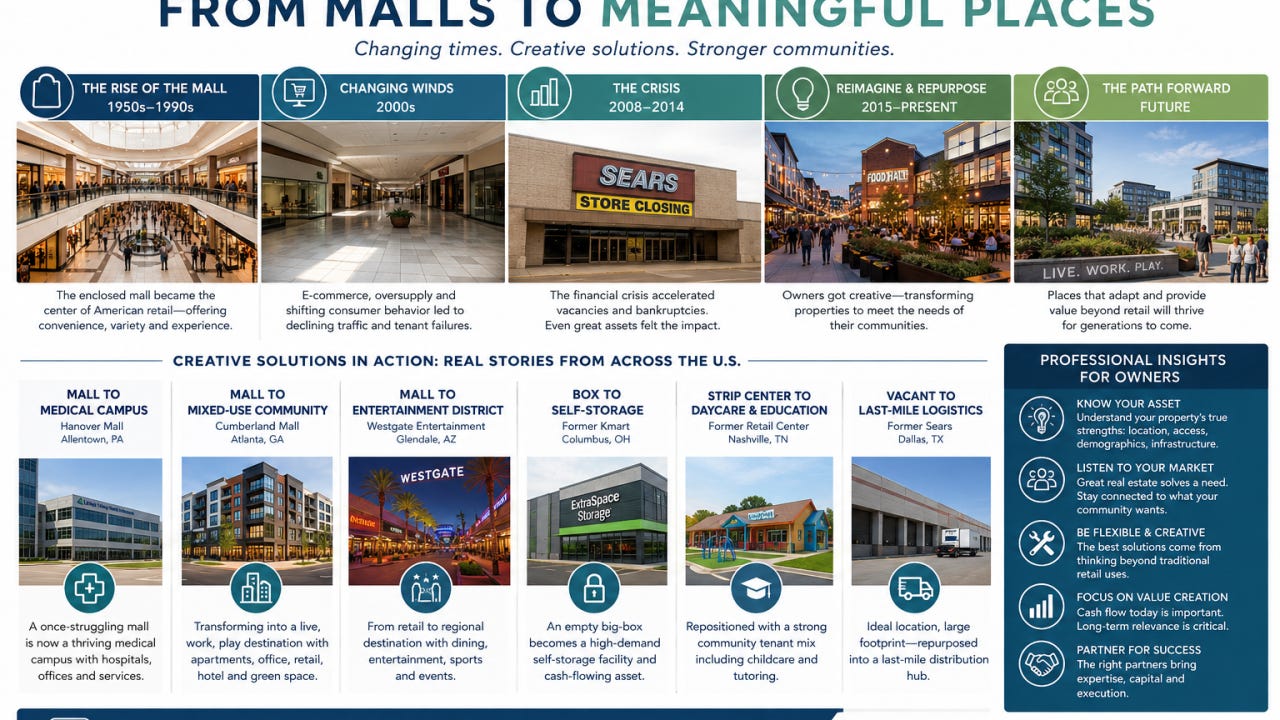
What Happened to the American Mall?
The enclosed mall model was built around department store anchors.
Properties depended heavily on stores like: Sears, JCPenney, Macy’s, and Lord & Taylor were once considered untouchable anchors of the American shopping mall ecosystem.
These anchors generated enormous customer traffic, which supported smaller inline tenants throughout the mall.
The entire ecosystem depended on sustained foot traffic.
When department stores began struggling nationally, the ripple effects spread across the industry.
At the same time, consumers increasingly shifted toward convenience-based shopping.
Why drive across town for routine purchases when products could be delivered directly to your door?
E-commerce fundamentally changed customer expectations.
But another issue was developing behind the scenes.
America became dramatically over-retailed.
For years, developers continued building retail square footage under the assumption that consumer spending growth would continue indefinitely. In many markets, there were simply too many malls, too many shopping centers, and too much redundant retail inventory.
Then came the 2008 financial crisis.
Many institutional retail owners were highly leveraged. Properties that appeared successful on paper suddenly faced refinancing challenges, declining sales, tenant closures, and tightening capital markets all at once.
Some owners survived. Others restructured. Others disappeared entirely.
The retail landscape would never look the same again.
The Real Estate Was Not Always the Problem
One of the biggest misconceptions surrounding struggling malls and retail centers is that the underlying real estate itself has no value.
In many cases, the opposite is true.
Some failing malls sit on extraordinarily valuable land:
prime intersections,
major highway corridors,
dense population centers,
established infrastructure,
utility-rich sites,
and highly visible commercial corridors.
What became obsolete was not necessarily the real estate.
It was the original business model.
That distinction matters.
Because once owners stop viewing a property solely as “retail,” entirely new possibilities emerge.
The Industry’s Shift Toward Repurposing
Today, some of the most successful redevelopment projects in America are former malls, strip centers, and big-box retail properties that were creatively repositioned into entirely different uses.
Owners across the country are proving that struggling retail assets can become highly successful again — if they are willing to rethink the purpose of the property.
The industry is no longer asking:
“How do we save the mall?”
Instead, owners are asking:
“What does this property need to become in order to remain economically relevant?”
That is a completely different mindset.
Healthcare and “Medtail” Expansion
One of the fastest-growing trends in retail repurposing has been healthcare integration.
Across the country, former retail space is being converted into:
urgent care centers,
orthopedic clinics,
imaging facilities,
med spas,
physical therapy centers,
outpatient surgery centers,
and specialty healthcare facilities.
Healthcare providers increasingly want visibility, accessibility, and parking convenience — all things traditional retail properties already offer.
Former department stores are particularly attractive because of their large floorplates and existing infrastructure.
Properties once dependent on fashion retail are now becoming healthcare destinations.
That would have seemed unimaginable twenty years ago.
Mixed-Use Development Is Reshaping Retail Real Estate
Perhaps the biggest transformation happening in commercial real estate today is the shift toward mixed-use environments.
The modern consumer increasingly wants convenience, experience, walkability, and lifestyle integration.
People want environments where they can:
live,
work,
dine,
socialize,
exercise,
and entertain themselves.
Developers are responding by converting aging retail properties into:
multifamily housing,
hotels,
entertainment districts,
office space,
food halls,
breweries,
public gathering spaces,
and experiential retail concepts.
In many cases, the property becomes more valuable after diversification than it ever was as a traditional retail center.
The future is less about isolated retail boxes and more about creating integrated community ecosystems.
The Owners Who Survived Learned to Think Completely Differently
The owners who survived this transformation were usually not the owners clinging to nostalgia.
They were the owners willing to completely rethink what their properties could become.
That is where the story gets interesting.
Because some of the most successful commercial real estate projects in America today were once viewed as dying malls or failing retail centers.
And the transformations happening across the country are honestly fascinating.
Creative Repurposing Is Happening Everywhere
What fascinates me most today is watching owners across the country completely reinvent retail assets that many people had written off as failures.
Some of the most successful projects in commercial real estate today were once considered dying properties.
And the owners who succeeded were usually the ones willing to stop thinking emotionally and start thinking creatively.
I remember a time in the industry when the idea of replacing retail with healthcare, apartments, or entertainment would have sounded absurd.
Today, it is becoming standard practice.
Across the country, former malls and retail centers are being transformed into entirely different ecosystems.
A former mall in Rhode Island was redeveloped into a combination of healthcare, apartments, and mixed-use concepts.
In Texas, former mall sites have been redeveloped into walkable lifestyle districts with housing, restaurants, entertainment, offices, and hotels.
In Ohio, former big-box stores have become self-storage facilities, medical offices, churches, and logistics space.
In Pennsylvania, struggling retail corridors have been repositioned around service-based tenants, healthcare,
In Ohio and Pennsylvania, former department stores have become churches, medical facilities, and office users.
Some failing malls added trampoline parks, luxury bowling alleys, climbing gyms, esports facilities, and entertainment concepts that now generate more traffic than traditional retailers.
Other properties completely abandoned retail altogether.
Former shopping centers are now:
logistics facilities,
call centers,
self-storage,
educational campuses,
municipal offices,
and multifamily developments.
One of the most interesting transformations I’ve seen nationally involved dead mall sites being redeveloped into walkable mixed-use districts with apartments, restaurants, entertainment, hospitality, and green space.
And honestly, many of those projects are far more economically resilient than the original malls ever were.
That is the future of commercial real estate.
Not simply leasing vacant storefronts.
Reimagining the entire purpose of the property.
Because the land still matters. The location still matters. The infrastructure still matters.
The use is what changed.
And the owners who survive long term will likely be the ones willing to challenge traditional assumptions before the market forces them to.
Retail Owners Need to Think Like Asset Managers
One of the biggest mistakes commercial property owners make is emotionally attaching themselves to what a property “used to be.”
A property does not care what it was originally designed for.
A property only cares whether it can continue generating economic value.
That requires owners to think like asset managers, not simply landlords.
The questions owners should be asking are:
What does the market currently need?
What demand exists in this corridor?
What uses are underserved?
What demographics are growing?
What traffic patterns have changed?
What infrastructure advantages does this property have?
What alternative uses could create stronger long-term value?
Sometimes the answer remains retail.
Sometimes it becomes healthcare.
Sometimes it becomes housing.
Sometimes it becomes logistics or entertainment.
The key is adaptability.
Smaller Retail Owners Face the Same Challenge
This conversation is not limited to enclosed malls.
The same principles apply to:
neighborhood strip centers,
standalone retail buildings,
former restaurants,
vacant pharmacies,
underperforming shopping plazas,
and aging commercial corridors.
Many owners are currently holding retail assets that were designed for a different economy.
Consumer behavior has changed. Traffic patterns have changed. Work habits have changed.
Owners who refuse to evolve may struggle.
Owners willing to rethink their assets often discover opportunities they never previously considered.
A struggling retail property does not automatically mean a failing property.
Sometimes it simply means the asset needs a new identity.
The Future of Retail Real Estate
Despite the headlines, retail real estate is not disappearing.
It is transforming.
Strong retail corridors still matter. Physical shopping still matters. Restaurants, entertainment, service retail, and experiential environments continue attracting consumers.
But the future of successful retail real estate will likely look very different from the past.
The most resilient properties moving forward will likely combine:
experience,
convenience,
mixed-use density,
healthcare,
entertainment,
hospitality,
housing,
and community integration.
The enclosed mall may no longer dominate American real estate the way it once did.
But many of the underlying properties still hold tremendous potential.
The owners who thrive in the next generation of commercial real estate will be the ones willing to think beyond the original blueprint.
Because sometimes the best solution for a retail property…
is no longer retail at all.
Originally published on LinkedIn on May 12, 2026. Republished here from the original article.
Emily C. Shortall, CPM®, ARM®, also known professionally as Emily Goodman Shortall and Emily Shortall, works in commercial and multifamily property management and provides operational advisory and separately engaged expert-witness services. Historical bylines are retained for attribution; they are not a statement of current credential status.