
Property Management Is Not an Afterthought — It Is the Business Plan
Why Owners and Asset Managers Need Operations at the Table Before Groundbreaking
By Emily Goodman Shortall, CPM®, ARM® (byline updated September 26, 2026)
There is a dangerous misconception in real estate development that still exists across our industry:
That property management begins when construction ends.
It does not.
Property management begins in design.
After more than two decades in real estate management, development, and operations, I can tell you with complete confidence that some of the most expensive mistakes in commercial and multifamily real estate happen long before the first tenant ever moves in.
They happen during planning meetings where nobody from operations is in the room.
They happen when architects, engineers, developers, and ownership teams design a building based on aesthetics, construction budgets, and lease-up assumptions — without fully considering how the property will actually function for the next 30 years.
And unfortunately, once concrete is poured and walls go up, operational inefficiencies become permanent.
From Institutional Real Estate to Community-Focused Development
Before returning to the Ohio Valley and launching Harvey Goodman Property Management in 2015, I spent years working in institutional real estate management overseeing large multifamily and commercial portfolios across multiple states.
One thing became very clear at every level of the industry:
The properties that perform best long term are rarely accidents.
Operational success is usually designed into the asset early.
Owners Need to Stop Thinking About Property Management as “Post-Construction”
One of the biggest shifts happening in commercial real estate today is the recognition that operational performance drives asset value just as much as acquisition strategy or development execution.
Organizations like IREM, BOMA International, CCIM Institute, and National Apartment Association increasingly emphasize lifecycle cost management, operational efficiency, tenant retention, and asset performance as critical drivers of NOI and long-term valuation.
The data supports it.
Research published through the Whole Building Design Guide and lifecycle cost studies tied to NIST standards show that operations, maintenance, and repair costs can account for 60–80% of a building’s total lifecycle cost. In many cases, operating and maintenance expenses exceed three times the original construction cost over the life of the asset.
Think about that for a moment.
Developers and ownership groups often spend months debating construction costs that represent only a fraction of what the building will ultimately cost to operate.
Yet the people responsible for managing those operational costs are frequently brought into the process near the end.
That approach no longer makes financial sense.
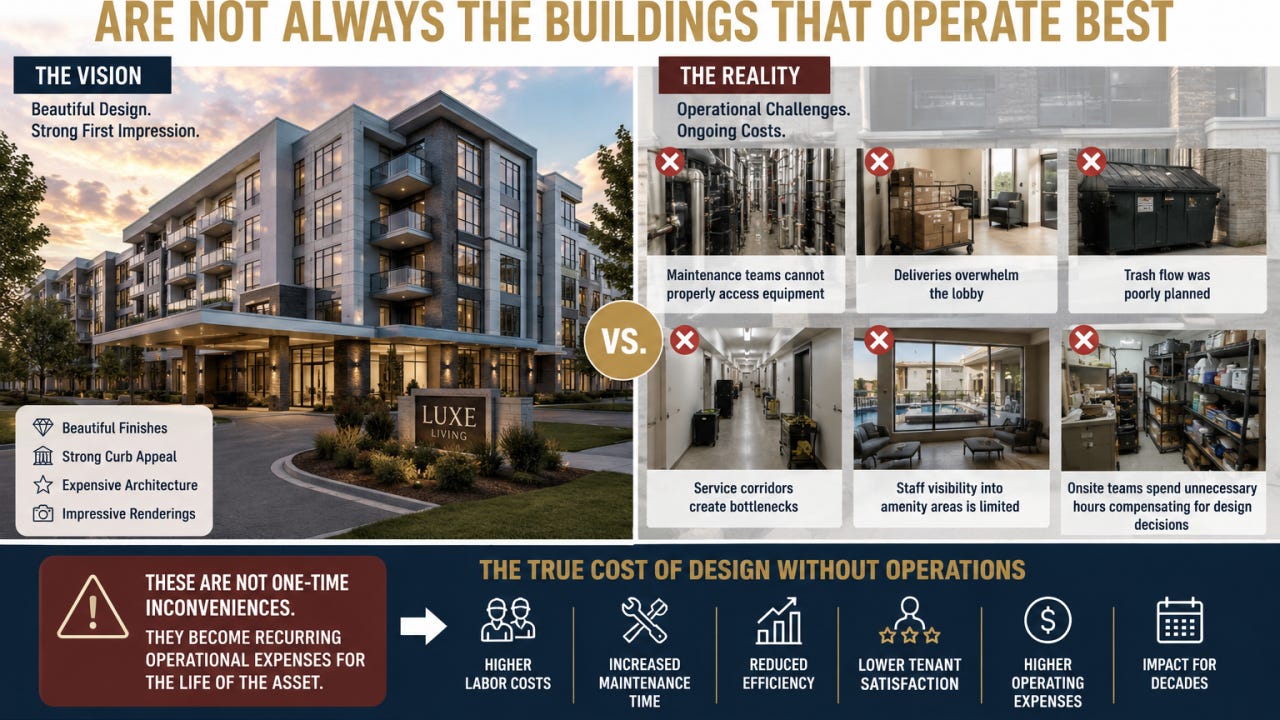
The Buildings That Look Best on Paper Are Not Always the Buildings That Operate Best
Some of the most operationally difficult buildings I have ever seen were also some of the most visually impressive.
Because beautiful design does not automatically equal operational efficiency.
Over the years, I have walked properties where you could immediately tell operations was never consulted during design.
Beautiful finishes. Strong curb appeal. Expensive architecture.
But then you begin operating the building and discover:
maintenance teams cannot properly access equipment,
deliveries overwhelm the lobby,
trash flow was poorly planned,
service corridors create bottlenecks,
staff visibility into amenity areas is limited,
or onsite teams spend unnecessary hours every week compensating for design decisions.
These are not one-time inconveniences.
They become recurring operational expenses for the life of the asset.
At scale, those inefficiencies become enormous.
During my years overseeing large portfolios, I saw firsthand how seemingly small operational issues become magnified across thousands of units and millions of square feet.
A maintenance task that takes an extra 15 minutes because of poor equipment access may not sound significant.
Multiply that inefficiency across hundreds of service requests, multiple technicians, and years of operations — and ownership ends up paying for those design decisions forever.
Property Managers Understand How Buildings Actually Function
Architects understand design.
Engineers understand systems.
Contractors understand construction.
Asset managers understand investment performance.
But property managers understand how buildings actually live and breathe every day.
We understand:
how residents move through spaces,
where bottlenecks occur,
what frustrates tenants,
what slows maintenance teams down,
what creates unnecessary labor costs,
what improves retention,
and what ultimately protects NOI.
That perspective cannot be replicated through renderings or underwriting models alone.
And frankly, it becomes more important every year.
The real estate industry is operating in an environment of:
rising labor costs,
increasing insurance expenses,
staffing shortages,
higher maintenance costs,
increased resident expectations,
and ongoing pressure on operating margins.
In markets like Eastern Ohio, West Virginia, and Western Pennsylvania, those pressures are even more pronounced.
Skilled maintenance labor is harder to find. Vendor costs continue rising. Operational inefficiencies become expensive very quickly.
Which means operational discipline matters more than ever.
Eventually Every Building Becomes an Operations Business
Our family has been developing, managing, and operating housing in the Ohio Valley for nearly 70 years.
When you operate assets for generations instead of simply developing and exiting them, you begin viewing buildings differently.
You think about:
durability,
maintainability,
resident experience,
staffing efficiency,
operational sustainability,
and long-term asset preservation.
Because the decisions made during development are often still impacting operations decades later.
As we continue expanding our own multifamily developments throughout the region, including projects like Richland Commons, operational planning is part of the discussion from the very beginning.
We evaluate projects not only through construction budgets and lease-up assumptions, but through:
maintenance accessibility,
turnover logistics,
staffing efficiency,
traffic flow,
service response capability,
technology infrastructure,
and long-term operational sustainability.
Because eventually every development becomes an operations business.
The Research Is Clear: Early Operational Involvement Reduces Long-Term Problems
Independent facilities management studies consistently show that involving operations teams during design dramatically improves maintainability and reduces long-term defects.
One major facilities management study found that early maintenance consultation during design reduced electrical, plumbing, and HVAC operational defects by as much as 30–90% in many projects.
Another key finding: The greatest operational benefit occurs during the early design stages — around 30% design completion — while the cost of fixing issues becomes exponentially higher later in the project.
That aligns perfectly with what experienced property managers already know.
It is dramatically easier to move a wall on paper than after occupancy.
It is dramatically cheaper to redesign a loading flow before construction than after turnover.
It is dramatically smarter to plan maintenance access during design than after technicians spend decades fighting avoidable inefficiencies.
Tenant Experience Is Operational — Not Just Marketing
Our industry also needs to stop separating “operations” from “tenant experience.”
The two are directly connected.
Research tied to tenant satisfaction across thousands of commercial buildings found that higher tenant satisfaction directly correlates with:
increased renewal probability,
lower vacancy growth,
stronger tenant loyalty,
and higher rent growth.
That should matter to every owner and asset manager.
Because tenant satisfaction is heavily influenced by operational execution:
maintenance responsiveness,
parking flow,
building comfort,
cleanliness,
package handling,
access systems,
communication,
service quality,
and common area functionality.
These are operational functions.
And operational success is heavily influenced by design.
In multifamily specifically, the stakes are enormous.
The National Apartment Association has reported that resident turnover can cost approximately $4,000 per unit once lost rent, repairs, concessions, marketing, and make-ready expenses are included.
When owners ignore operational planning, they are often unintentionally designing future turnover costs directly into the asset.
The Industry Needs to Break Down the Silos
One of the biggest operational weaknesses in development today is siloed decision-making.
Development teams operate separately from leasing. Leasing operates separately from construction. Construction operates separately from management. Management gets brought in near the end and told to “figure it out.”
That is backwards.
The strongest projects happen when:
ownership,
asset management,
property management,
leasing,
construction,
architecture,
and engineering
…all collaborate early.
Not because everyone always agrees.
But because friction during planning prevents failure during operations.
Our company has operated on EOS for years because operational discipline matters.
Buildings operate best when accountability, systems, communication, and operational processes are intentionally designed — not improvised after opening.
Property Managers Are Not Just Operators — They Are Strategic Asset Partners
This is the fundamental point owners and asset managers need to understand:
Property management is not simply about collecting rent and responding to maintenance requests.
At its highest level, property management is asset management.
It is the daily execution of the owner’s investment strategy.
Property managers are long-term stewards of the asset.
We are responsible for protecting:
NOI,
tenant relationships,
asset reputation,
retention,
operational efficiency,
service execution,
expense control,
and long-term value preservation.
And those responsibilities begin long before opening day.
Operational excellence is not something that magically appears after certificate of occupancy.
It is designed into the building from the very beginning.
After more than 20 years in property management, development, and asset operations, one lesson continues to repeat itself:
The long-term success of a building is usually determined long before the first resident moves in.
The owners who consistently outperform understand that property management is not an afterthought.
It is one of the most important strategic voices in the development process.
Because eventually every building becomes an operations business.
And operational excellence begins in design.
Research and industry guidance referenced from IREM, BOMA International, CCIM Institute, National Apartment Association, and lifecycle cost research from Whole Building Design Guide and NIST Building Lifecycle Cost Program.
Originally published on LinkedIn on May 19, 2026. Republished here from the original article.
Emily C. Shortall, CPM®, ARM®, also known professionally as Emily Goodman Shortall and Emily Shortall, works in commercial and multifamily property management and provides operational advisory and separately engaged expert-witness services. Historical bylines are retained for attribution; they are not a statement of current credential status.