
By Emily Goodman Shortall, CPM®, ARM® (byline updated September 26, 2026)
Property Management and Asset Management are often discussed as separate disciplines within commercial real estate.
Technically, they are.
But in practice, the strongest-performing office and retail assets are rarely created through separation.
They are created through alignment.
After more than two decades in institutional real estate management, development, and operations — overseeing office, retail, and multifamily assets ranging from regional shopping centers to large portfolio operations — one reality has become increasingly clear:
The highest-performing commercial assets are not managed through handoffs between departments. They are managed through continuous communication between operations and strategy.
Because the space between Property Management and Asset Management is often where the most important value creation occurs.
Property Management Is Where the Asset Tells the Truth
Asset managers evaluate performance through metrics:
NOI
Occupancy
Leasing spreads
Capital allocation
Property managers experience the asset differently.
We experience the building in real time.
We see:
the failing HVAC system before it becomes a capital event
the tenant frustration before it becomes non-renewal
the declining traffic pattern before it shows up in sales
These are not isolated inconveniences.
They are operational signals.
And research consistently shows that operational execution directly influences leasing decisions, tenant retention, and financial outcomes. [link.springer.com], [jonasvar.com]
Property Management is where the asset tells the truth — often long before the numbers reflect it.
Asset Management Converts Operational Signals Into Investment Strategy
At its best, Asset Management translates those signals into action:
reallocating capital
adjusting leasing strategy
repositioning tenant mix
protecting NOI
That is where the conversation shifts from:
“Did we fix it?”
…to:
What does this mean for retention?
What does this mean for value?
Property managers protect performance.
Asset managers convert performance into value creation.
Case Study 1: Office Asset Repositioning Through Operational Feedback
A mid-sized suburban office portfolio in the Midwest faced rising vacancy following the shift to hybrid work.
Initial asset-level analysis focused on market conditions and rental rates.
But operational data told a different story.
Property management teams identified:
slow maintenance response times
outdated common areas
declining tenant engagement
underutilized amenity space
Rather than relying solely on market comps, ownership aligned asset strategy with operational insight:
capital was redirected toward amenity upgrades and shared workspace environments
service delivery standards were restructured
tenant engagement programming was introduced
The result:
increased tenant satisfaction
measurable improvement in renewal conversations
improved leasing velocity without significant rent reduction
This reflects a broader industry trend: tenant engagement and experience are now recognized as direct drivers of leasing performance and retention in office environments. [lpc.com]
The value was not created through a market shift.
It was created through alignment.
The Industry’s Biggest Mistake: Separating Operations and Strategy
Many organizations still operate under an outdated assumption:
Property Management is reactive
Asset Management is strategic
In reality, that separation creates inefficiency.
Lifecycle research shows that misalignment across operations and investment strategy leads to suboptimal performance, missed opportunities, and increased costs. [pwc.com]
Even more significantly:
Operations and maintenance represent 75–80% of total asset lifecycle costs [re-leased.com]
Yet in many organizations, the team responsible for those costs is not fully integrated into investment decision-making.
That gap is where value is lost.
Case Study 2: Retail Center Performance Driven by Tenant Mix and Operations
A regional shopping center experienced stable occupancy but declining tenant sales and weak renewal momentum.
Financial reporting alone suggested stability.
Operational insight told a different story.
Property management identified:
poor tenant adjacency
declining cross-shopping patterns
uneven foot traffic distribution
lack of coordinated merchandising strategy
Asset management responded by aligning leasing strategy with operational data:
repositioning anchor tenants
rebalancing tenant mix
clustering complementary retailers
enhancing customer flow through reconfiguration
This approach mirrors industry findings that consumer shopping patterns—and tenant adjacency—directly influence traffic, dwell time, and overall asset performance. [retail-insider.com]
The result:
increased cross-shopping activity
improved tenant sales performance
stronger lease renewals
The property had not been failing.
It had been misaligned.
Tenant Experience Is a Financial Strategy — Not an Operational Detail
The data is clear:
Tenant satisfaction drives retention and revenue stability [datacalculus.com]
Retention directly protects NOI and reduces turnover cost [ross-companies.com]
Service quality correlates with vacancy reduction and asset value growth [aktivbo.com]
In modern commercial real estate:
Operations are not overhead. They are a primary driver of investment performance.
Office and Retail Assets Are Operational Ecosystems
Commercial assets today function as interconnected systems.
Office:
workplace experience
service responsiveness
amenity relevance
Retail:
tenant mix
customer behavior
traffic patterns
All are interdependent.
A property can appear stable on paper while deteriorating operationally.
And by the time financial performance reflects it, value has already eroded.
Case Study 3: Lifecycle Alignment in Capital Planning
A large institutional owner managing a multi-asset portfolio implemented a lifecycle-based asset management strategy to better align operations and capital planning.
Historically:
capital decisions were made reactively
maintenance data was fragmented
operational teams had limited input into long-term planning
After integration:
property management data was used to predict asset failure
capital planning aligned with real operational conditions
preventative maintenance replaced reactive repairs
Industry benchmarks show this type of lifecycle alignment can:
reduce maintenance costs by 10–30%
improve energy efficiency by 5–15%
significantly enhance long-term asset value [re-leased.com]
The key driver was not technology.
It was alignment between operations and investment strategy.
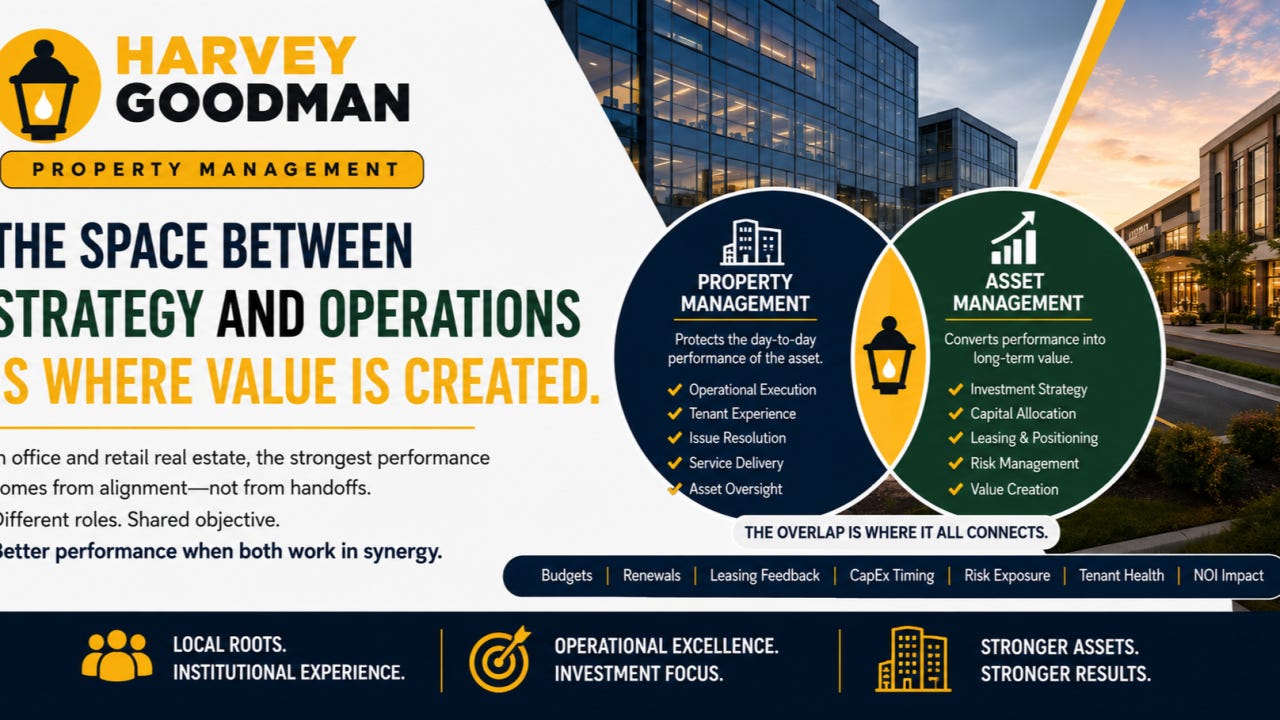
The Overlap Is Where Value Creation Happens
The most important work happens in the overlap:
budgeting
forecasting
capital planning
leasing strategy
tenant retention
operational performance
This is where:
property managers identify patterns
asset managers prioritize investment
ownership drives execution
Individually, each function is effective.
Together, they are transformative.
The Best Assets Are Managed Through Alignment — Not Handoffs
Across institutional and local ownership structures, the pattern is consistent:
The strongest assets are aligned assets.
Alignment ensures:
operational insight informs capital decisions
tenant experience supports revenue growth
risks are identified early
strategy reflects reality
In today’s environment—defined by cost pressure, changing tenant expectations, and evolving market dynamics—this alignment is no longer optional.
It is a competitive advantage.
Different Roles. Shared Objective.
Property Management and Asset Management are different disciplines.
They should remain distinct.
But they should never be disconnected.
Because commercial real estate performance today is not driven by isolated expertise.
It is driven by integration.
Operations inform strategy. Strategy guides investment. Alignment drives performance.
Different roles.
Shared objective.
And the strongest assets are built — consistently — in the space where those roles intentionally overlap.
Originally published on LinkedIn on May 18, 2026. Republished here from the original article.
Emily C. Shortall, CPM®, ARM®, also known professionally as Emily Goodman Shortall and Emily Shortall, works in commercial and multifamily property management and provides operational advisory and separately engaged expert-witness services. Historical bylines are retained for attribution; they are not a statement of current credential status.